
Claritas
Józef Krzysztof Oraczewski
Solo Exhibition
In Claritas, Józef Krzysztof Oraczewski approaches light not as an instrument of representation, but as the principal subject of artistic and philosophical reflection. This shift is fundamental to the logic of the work: light is no longer used to reveal the image, but is itself revealed through image, space, and symbol. The artist deliberately reverses the traditional order of seeing, transforming what usually remains a means of expression into the very core of the experience.
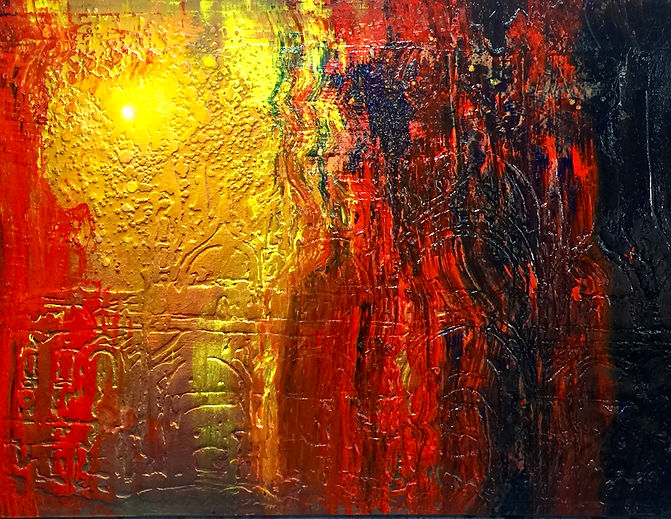
Claritas unfolds between two distinct yet mutually complementary orders. On the one hand, there is an austere, almost ascetic space shaped by a lamp, a candle, a point source of light, shadow, and emptiness. It evokes an atmosphere of concentration, withdrawal, and intense intellectual effort, suggesting associations with a cell, a cave, or a place of contemplation. On the other hand, the installation is equally formed by a painterly dimension—dense, sensuous, and saturated with colour, texture, and the layered memory of culture. It is precisely within this tension between intellect and matter, between contemplation and visual intensity, that the work achieves its full resonance.
Oraczewski presents light as one of the most capacious, and at the same time one of the most ambiguous, concepts in culture. Here, light is associated with cognition, spirituality, order, and transcendence, but also with uncertainty, distance, and the limits of human vision. In this sense, Claritas does not propose a simplified affirmation of brightness, nor a merely decorative vision of illumination. On the contrary, it reveals that any movement toward the essence of light also leads toward what is difficult, unstable, and internally unresolved. Light may disclose, but it may also blind.
An important dimension of the installation is the presence of tradition, understood not as a passive background, but as a living structure of meanings that continues to shape perception. In the layered surfaces of the paintings, their material density, and their relief-like presence, one senses the conviction that culture, philosophy, religion, and history leave a lasting trace in the ways we see and interpret reality. Even the most individual vision never emerges from a void. In Claritas, light therefore appears not merely as a visual phenomenon, but as a symbol charged with the accumulated memory of centuries.
The title itself refers to the classical notion of claritas—clarity understood not only as luminosity, but also as intelligibility, revelation of essence, inner radiance, and the legibility of form. In Oraczewski’s work, however, such clarity does not arrive as ready-made certainty. It appears rather as a horizon toward which art moves, without ever reducing it to a single image or definition. Claritas does not so much explain the world as give form to the very desire for explanation—a desire that remains one of the fundamental tensions of human experience.
The result is an installation that does not eliminate contradiction, but sustains it within a coherent artistic structure. Claritas is a work about light, but also about the limits of knowledge, about the relation between the visible and the invisible, and about the human need for meaning in a world marked by fragility and incompleteness. Oraczewski presents art as a space in which what cannot be fully reconciled on the level of concepts may nevertheless be integrated on the level of experience—not through simplification, but through form.
Monika Turczyńska
ORAC Gallery
December 18, 2024
February 13, 2025


