
Lux Tessera
Józef Krzysztof Oraczewski
Solo exhibition
Lux Tessera is an exhibition by Józef Krzysztof Oraczewski centered on light understood not merely as a visual phenomenon, but as a bearer of meaning, experience, and spiritual intensity. Its title refers to the ancient meaning of the tessera — a fragment of a mosaic, but also a token of recognition, a symbolic key granting access to a particular space. In this double sense, Lux Tessera becomes a reflection on light as a form of passage: from dispersion toward wholeness, from tension toward inner order, from separation toward the possibility of encounter.
In the works presented, light does not serve a purely formal function. It is not used simply to reveal form or to establish atmosphere. Rather, it operates as an organizing principle from within the image itself — a force that allows opposites to coexist without erasing their distinctness. It is precisely here that one of the exhibition’s central dimensions emerges: the movement from confrontation toward an alchemy of union. In place of the logic of conflict, one finds a logic of transmutation, in which difference enters into relation and attains a new state of coherence.
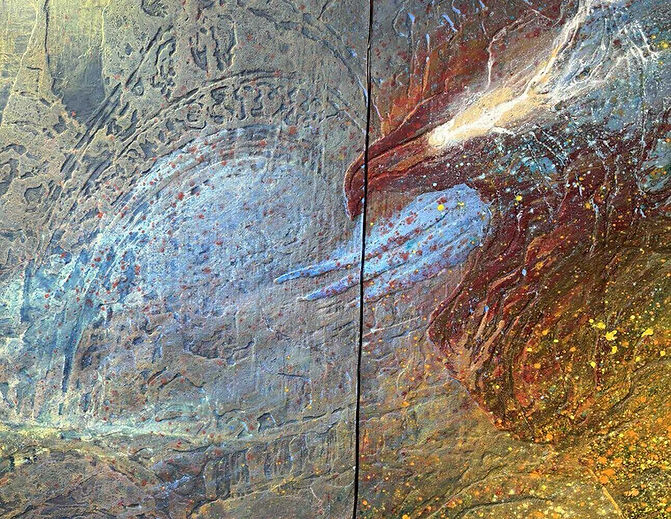
A significant element within this symbolic structure is the figure of the lion and the eagle — two signs rooted in different cultural and imaginative orders, which in Oraczewski’s work do not appear as opposing emblems of power, but as forms of possible unity. The lion, deeply associated with Venice and its iconography, encounters the eagle, which carries another field of history, another symbolic lineage, another horizon of imagination. Their conjunction is not illustrative. It becomes a symbolic language of encounter in which difference is not negated, but transformed into a new constellation of meaning. In this sense, Lux Tessera may also be read as a meditation on the relation between Venice and Poland — not at the level of literal reference, but as an attempt to articulate the possibility of a spiritual and cultural dialogue.
Equally important is the very idea of the mosaic embedded in the notion of the tessera. A mosaic does not arise from uniformity, but from fragments. Its strength lies not in the elimination of difference, but in the arrangement of disparate elements in such a way that a higher principle of harmony may emerge between them. Oraczewski’s exhibition works precisely through this logic: it constructs images in which color, symbol, and formal tension remain distinct, yet are drawn into a process of unification. Light becomes not only the subject of the exhibition, but the condition of this transformation — the medium that does not abolish multiplicity, but allows it to appear as a whole.
Lux Tessera presents art as a space in which unity may be experienced not through simplification, but through a deeper reconciliation of opposites. It is an exhibition about light, but also about passage; about symbol, but also about the inner labor of the image; about beauty understood not as a surface effect, but as the result of tension, duration, and the gradual disclosure of meaning. In this sense, light becomes not merely an image of visibility, but a sign of that which leads toward a fuller experience of presence.
Monika Turczyńska
A Space Koszykowa, Warsaw
September 25, 2025
November 27, 2025


