
MINORIA — Condensed Trace | Oraczewski
Józef Krzysztof Oraczewski
Solo Exhibition
MINORIA — Condensed Trace presents a new body of work by Józef Krzysztof Oraczewski, developed within an ongoing curatorial framework investigating the relationship between form, perception and emergence.
Conceived as a project unfolding through successive chapters, MINORIA does not advance through a linear narrative, but through shifts in intensity. Each chapter constitutes a distinct condition within a broader field — not illustrating a fixed idea, but testing the circumstances under which the image begins to appear and, crucially, how it resists stabilisation.
Within this framework, Oraczewski’s practice operates at a threshold. His works do not begin with representation, nor do they aim to resolve into a singular, definitive image. Instead, they develop through the gradual accumulation of gesture, material and internal tension. Visual structures emerge, dissolve and reconfigure, without consolidating into a stable composition. What is presented is not an image to be read, but a field in which perception unfolds.
The surface plays a central role in this configuration. It is not treated as a passive support, but as an active site of condensation — a place where multiple forces intersect without closure. Material does not serve to construct representation; it records an event. Pigment accumulates as residue, gesture persists as trace, and the image remains suspended within a state of ongoing formation.
A significant part of the works is executed in dry pastel on paper. This medium retains a direct sensitivity to touch, registering even the most subtle variations of pressure and movement. The edges of the paper — irregular, worn, and at times deliberately burned — do not function as a frame, but as an exposure of the work’s limits. They mark the point at which the image ceases to be contained and instead reveals its conditions of appearance.
In this sense, the support is no longer neutral. The paper carries traces of fragility, interruption and transformation. The work does not sit on the surface; it occurs within it. The material condition of the image becomes inseparable from its perceptual and conceptual structure.
The exhibition is organised as a perceptual sequence rather than a narrative progression. Individual works function as condensed traces of ongoing transformation, while their spatial arrangement produces a shifting field of attention. The viewer is not guided towards a fixed interpretation, but remains within a condition of sustained observation, in which the act of seeing is slowed, extended and continuously renegotiated.
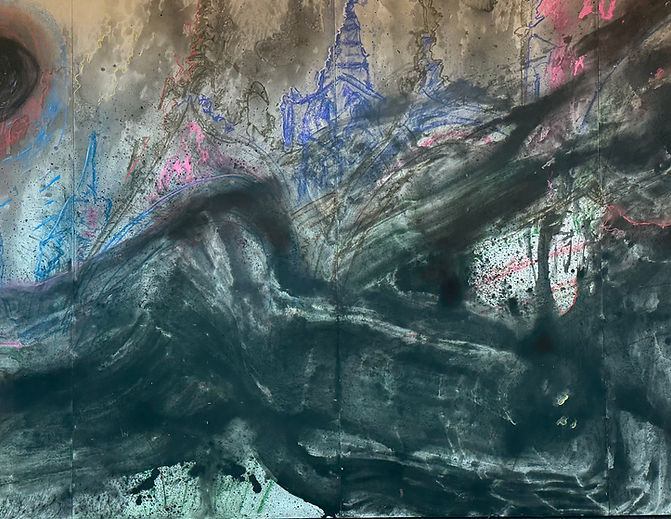
At the centre of the exhibition, a large-scale painting establishes a primary field in which the internal logic of the project becomes most visible. Rather than extending the language of the smaller works, it introduces a distinct condition — one in which structure and dissolution coexist within a single visual plane. The image unfolds across multiple layers without stabilising into a hierarchical composition.
The scale fundamentally alters perception. The viewer is no longer positioned in front of the work, but within its field. Gesture expands, tensions accumulate, and the surface becomes a continuous zone of interaction between emergence and erasure. Darker zones absorb and delay attention, while luminous fragments appear as interruptions rather than focal points. No element resolves the composition; no final image is consolidated.
In this sense, the central work does not function as a culmination, but as a condensation — a state in which multiple processes overlap without closure. It does not conclude the exhibition, but intensifies its internal dynamics.
Across the exhibition, the notion of trace becomes central. A trace is neither representation nor absence; it is the mark of something that has occurred without becoming fully present. The works operate precisely at this level — as condensed traces of processes that remain partially concealed, resisting full disclosure.
MINORIA — Condensed Trace proposes a shift from interpretation towards attention. What is at stake is not the decoding of meaning, but the experience of a perceptual condition in which the image remains open, unstable and unresolved.
Within the broader framework of MINORIA, this chapter does not define a style, but articulates a condition — one in which form continues to emerge without closure, and in which the act of seeing itself becomes the primary site of the work.
Monika Turczyńska
A Space Gallery
May 9, 2026
May 23, 2026


